
How to Dispose of Insulation Panels in the UK: A Contractor’s Guide
A practical compliance guide for construction contractors, FM managers, and procurement teams
If you are managing a building refurbishment, demolition, or strip-out, there is a good chance insulation panels are involved. These panels, sometimes called sandwich panels or composite panels, are widely used across warehouses, retail units, factories, cold stores, schools, and hospitals.
What many operations and procurement teams do not realise is that some of these panels are classified as hazardous waste. Getting the disposal wrong can result in legal liability and regulatory enforcement. This guide explains what you need to check, what the rules require, and who is responsible for what.
This guide is relevant if you are involved in:
• Demolishing or refurbishing a building that uses insulated panel cladding on its roof or walls
• Removing cold store panels, food processing linings, or internal compartment walls
• Managing or procuring a contractor to carry out this kind of work
• Signing waste transfer documentation on behalf of a site or organisation
The EPIC Guide (Insulated Panels: Identification, End of Life and Re-use Options, June 2022) notes that relatively few metal-faced insulated panels have entered the waste stream to date, meaning many contractors have had little experience of how to dispose of them correctly.

The single most important compliance factor for insulation panel disposal is whether the panel contains Ozone Depleting Substances (ODS). This depends entirely on the age and core type of the panel.
Here is a simplified break down of the three main eras:
These older panels are likely to contain Chlorofluorocarbon (CFC) blowing agents. CFCs are classified as ODS and are subject to the strictest regulatory requirements.
This era saw a transition to Hydrochlorofluorocarbon (HCFC) blowing agents. HCFCs still carry Ozone Depleting Potential (ODP), approximately 10% of CFCs, and are also classified as ODS. Both CFC and HCFC panels require specific treatment at end of life.
All panels produced in the UK since 1 January 2004 are PIR pentane-blown and are non-ODS and non-hazardous within any classification of the current hazardous waste regulations.
Important note on HFC panels: Some panels produced between roughly 2000 and 2004 used Hydrofluorocarbon (HFC) blowing agents. These are not classified as hazardous waste under ODS regulations. However, HFC panels do contain gases with a Global Warming Potential (GWP) above 150, which must be noted on the waste transfer documentation. The EPIC Guide recommends that normal recycling or shredding processes are appropriate for HFC panels, provided the foam is reduced to pellet size rather than dust, which limits gas release. Source: EPIC Guide, Section 1.3
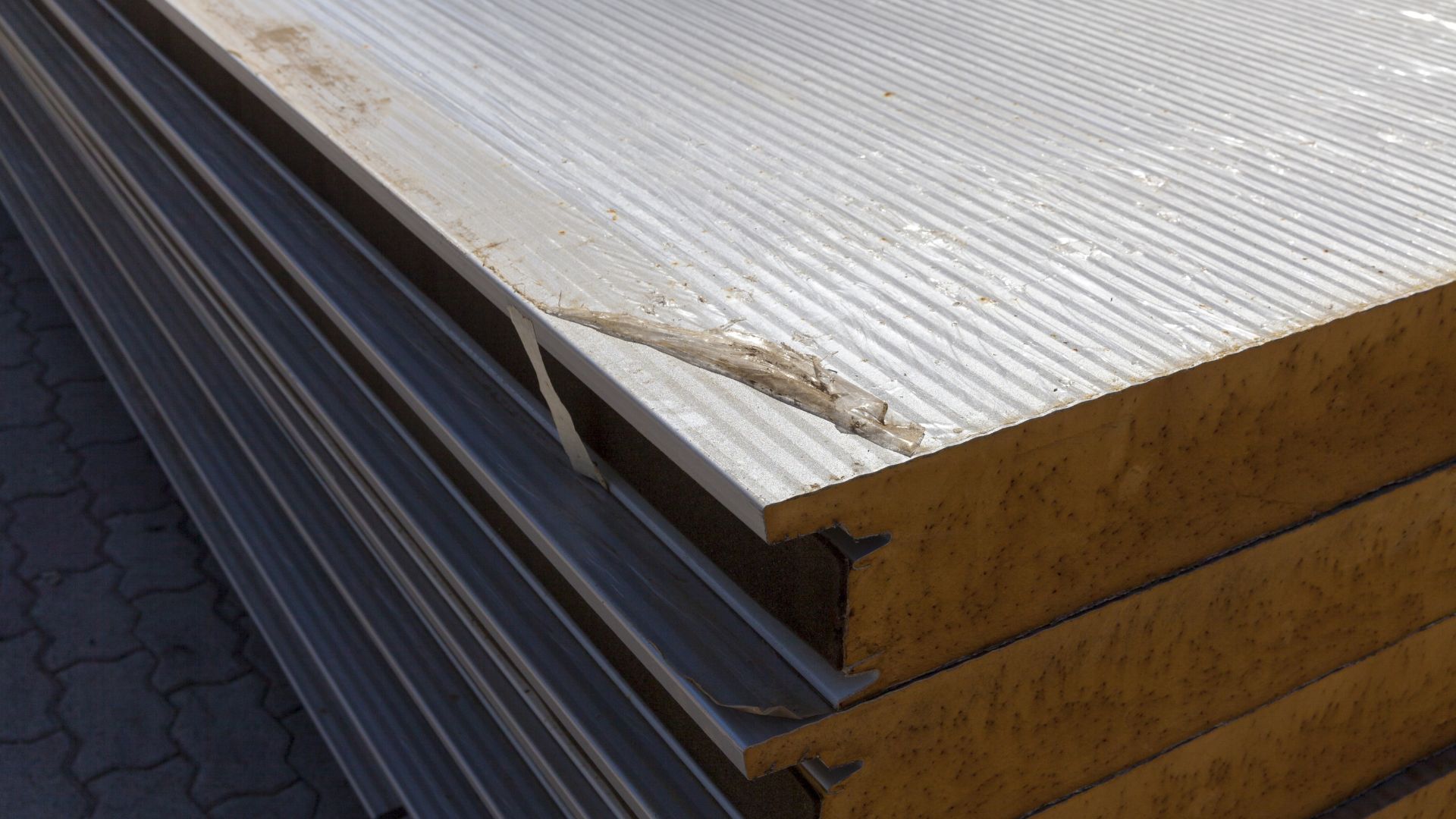
The core material is what determines how you must dispose of the panel. The EPIC Guide sets out a three-step identification process:
Insulated panels are often confused with site-assembled cladding systems, which are treated differently. A key visual clue: insulated panels typically have a flat or micro-rib internal face, while site-assembled systems tend to have a deeper profiled liner (around20mm or more).
The core materials you may encounter are:
• Polyurethane (PUR) or Polyisocyanurate (PIR) rigid foam - the most common for external roofs and walls. Over 90% of external panels use one of these. Age is critical here.
• Mineral Wool (MW) - used in some wall panels.Not classified as ODS.
• Polystyrene (EPS or XPS) - used mainly in cold stores and food industry applications. Not classified as ODS.
• Phenolic foam (PF) - rare, used on specific internal applications.
You cannot visually tell the difference between pre- and post-2004 PIR or PUR panels. The EPIC Guide recommends checking:
• Building records, CDM Health and Safety files, or architect/contractor records
• Panel markings - most post-2004 panels have manufacturer, date, and core type marked on joint tape or UV-marked on the face
• Contacting the manufacturer using any available markings
• Physical testing if no records are available
A practical rule: The EPIC Guide notes that panels with an external thickness of 30mm or 35mm were almost certainly produced before the 1990s and are likely to contain ODS. Beyond that, thickness alone is not a reliable guide.
The key piece of legislation governing the movement of hazardous waste is The Hazardous Waste (England and Wales) Regulations 2005 (SI 2005/894), as amended.
The 2005 Regulations explicitly apply to England and Wales only. Wales has additional specific provisions under Part 11 of the same Regulations.
Source: Hazardous Waste (England and Wales) Regulations 2005,Regulation 1(2) and 1(3)
Scotland and Northern Ireland: Separate hazardous waste frameworks apply in Scotland (the Special Waste Regulations 1996 as amended) and Northern Ireland. This guide does not cover those regimes. If your site is in Scotland or Northern Ireland, seek specific regulatory guidance from SEPA (Scotland) or NIEA (Northern Ireland) respectively. The authors have not verified the current state of those regimes from the sources provided.
The Regulations define waste by reference to the Waste Directive (Directive 2008/98/EC, as it applies in England). Waste management must be carried out without endangering human health, without harming the environment, and in particular without risk to water,air, soil, plants or animals.
Source: Hazardous Waste (England and Wales) Regulations 2005,Regulation 2
In practical terms for insulated panels: ODS-containing panels (CFC and HCFC) are classified as special or hazardous waste. This triggers specific obligations around transportation and processing.

If your panels are classified as hazardous waste (i.e., they contain CFC or HCFC blowing agents), the EPIC Guide sets out what this means operationally:
• No crushing on-site. ODS-containing panels cannot be crushed or shredded on the demolition site.
• Consignment notes required. The movement of hazardous waste must be tracked using consignment notes (these are a formal record of who produced the waste, who transported it, and where it went).
• ODS recovery plants only. Processing must go through facilities equipped to recover ODS, the EPIC Guide uses fridge recycling facilities as an example of this type of plant.
• Permit check. Always verify that the waste processing or recycling plant you are using holds a permit that allows it to accept the specific type of panel you are disposing of. This applies regardless of hazardous classification.
Non-ODS panels are not subject to hazardous waste transport restrictions or consignment note requirements.However, normal duty of care obligations still apply: waste must be properlydescribed on the waste transfer note, transported by a licensed carrier, and sent to a facility with the appropriate permit.
Regardless of whether panels are hazardous or non-hazardous, the EPIC Guide and the wider regulatory framework require that you consider disposal options in this order of preference (from best to last resort):
• Re-use - can the panels be dismantled and used elsewhere? The EPIC Guide covers dismantling for re-use in Section 6.
• Recycling
• Energy recovery (using the panel as a fuel source)
• Landfill - last resort
The EPIC Guide notes that for ODS panels, re-use or recycling through appropriate channels is strongly preferred over simple waste disposal. For non-ODS panels, recycling or shredding at a permitted facility is the standard route.
Your waste transfer note or consignment note must accurately describe the waste. Based on the EPIC Guide,this should include:
• Whether the panel contains ODS (CFC or HCFC blowing agents)
• If HFC-blown: note that the panel contains gases with a GWP above 150. The EPIC Guide states this should be clearly referenced on the duty of care/waste transfer note.
• The core type (PUR/PIR, MW, PS, etc.) if known
• Whether the panel is pre- or post-2004, if determinable
If you genuinely cannot identify the panel type: The EPIC Guide recommends contacting the manufacturer (using any available markings), checking CDM files, or arranging physical testing. Do not guess or leave the classification blank. Duty of Care regulations require the waste producer to properly describe their waste.
No. Regulatory responsibility differs across the four nations, and this is a practical point for any organisation operating across multiple sites.
England: The Hazardous Waste (England and Wales) Regulations 2005 apply in full. The Environment Agency (EA) is the relevant regulator.
Source: Hazardous Waste (England and Wales) Regulations 2005,Regulation 1(2)
Wales: The same 2005Regulations apply to Wales, with additional specific provisions set out in Part11. Natural Resources Wales (NRW) is the relevant regulator. The Regulations state that nothing in the main body of the Regulations applies to Wales except as specifically provided.
Source: Hazardous Waste (England and Wales) Regulations 2005,Regulation 1(3)
Scotland: A separate regime applies. The 2005 Regulations do not extend to Scotland. SEPA (Scottish Environment Protection Agency) is the relevant regulator. We have not verified the current details of the Scottish regime from the sources provided - seek specific guidance if you are operating in Scotland.
Northern Ireland: A separate framework applies under Northern Ireland legislation. The Northern Ireland Environment Agency (NIEA) is the relevant regulator. We have not verified the current details of the Northern Ireland regime from the sources provided - seek specific guidance if you are operating in Northern Ireland.
This article draws only on the following two sources. No other information has been added.
• EPIC (European Panel Federation) - Insulated Panels:Identification, End of Life and Re-use Options, June 2022, Revision 4.Available at: epic.uk.com
• The Hazardous Waste (England and Wales) Regulations2005 (SI 2005/894), as amended to 27 February 2025. Available at:legislation.gov.uk
Find out more on our insulation panel recycling service page.
Book a free review with our team. We'll look at how your organisation disposes of electricals today and show you exactly where your documentation falls short.