Small WEEE Disposal for Commercial Office Buildings
Small WEEE disposal is a hidden compliance risk in commercial office buildings. Learn how a WEEE box scheme helps building managers meet their duty of care and support ESG reporting.
Walk into the storeroom of most commercial office buildings and you will find the same thing: monitors nobody has claimed, keyboards from a previous tenant, cables that outlasted the devices they came with. None of that is a compliance issue, until it is thrown into the general waste bin.
Small waste electrical and electronic equipment (WEEE) accumulates in office buildings because responsibility for it rarely sits with anyone specifically. It falls between the FM team and the tenants, between the building manager and the waste contractor. Without a designated route, it ends up in the wrong place.
The duty of care under Section 34 of the Environmental Protection Act 1990 applies to every business that produces, handles, or disposes of controlled waste. Commercial waste is considered controlled waste. Electrical items are subject to additional requirements under the Waste Electrical and Electronic Equipment Regulations 2013, which prohibit WEEE from being disposed of as unsorted general waste and require it to be handled through authorised routes.
There is no minimum threshold. A single broken keyboard disposed of in the general waste bin is, in principle, a breach. The duty of care applies from the moment an item is discarded and is classified as waste until it reaches a licensed facility. Passing items on to a general waste contractor who has no authorisation to handle WEEE does not remove the responsibility of the duty of care for that item.
For building managers, the practical consequence is this: if WEEE is going into general waste on your premises, the building is part of that compliance chain whether you generated the waste or not.
The category covers more than most building managers expect. Under the WEEE Regulations 2013, the relevant items include:
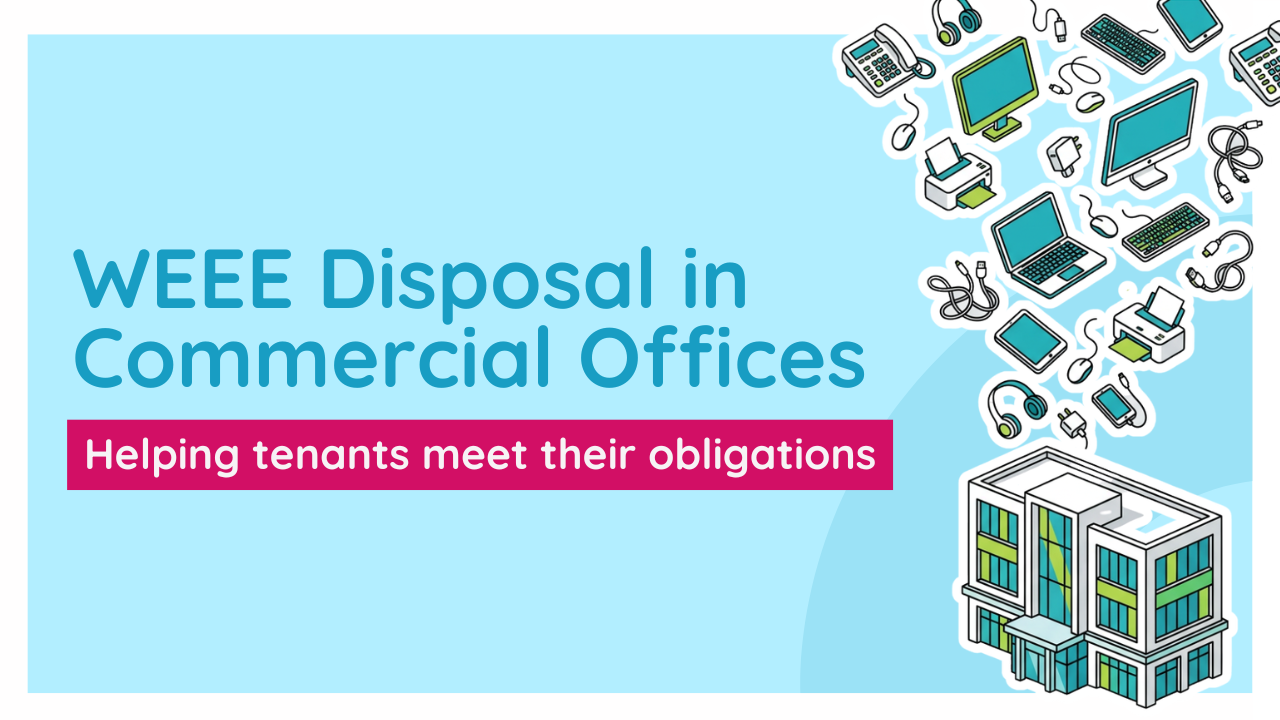
Every day work equipment like keyboards, screens, mice, USB hubs, desk phones and conference call equipment. It covers items taken out of the office like mobile phones, tablets, and their charging cables. The equipment to keep staff comfortable such as kettles, toasters, coffee machines, desk fans and portable heaters. It also covers battery-powered devices of almost any kind.
In a multi-tenant office building, these items are being bought and used constantly across multiple floors and multiple occupiers. A company may refresh its laptops, replace its phone handsets, swap monitors and often the teams don’t know their WEEE obligations in detail, if at all. Most buildings don’t offer their tenants a place to put their electrical waste or draw attention to the need to dispose of equipment properly.
So without a designated collection route, items go in the bin.
Under UK law, tenants are responsible for their own business waste, including their WEEE. That makes sense. However, if incorrect disposal is happening across multiple tenancies in your building, especially in communal areas, your bin stores, or via your waste contractor, it puts your building at risk.
It’s important to note that providing a WEEE collection point does not transfer tenant obligations onto the office building. Instead, it removes the risk of a problem. Tenants have a compliant route with zero effort on their part. The collection process creates a documented record that WEEE has been handled correctly. The building manager can demonstrate taking reasonable action to prevent non-compliant disposal on their premises. This also becomes a value-add to your tenants.
Waste transfer notes issued by a licensed WEEE collector are the audit trail that demonstrates compliance. Without them, there is nothing to show the Environment Agency if questions are asked.
A WEEE box scheme, like the one offered by GAP, places secure collection containers in communal areas of the building. These typically go near bin rooms, service lifts, or reception areas on each floor. Tenants can deposit small electrical items as needed. The boxes are collected on an agreed schedule or on an ad-hoc basis, and the WEEE items are processed through an authorised treatment facility. Waste transfer notes are then provided as a documented record of compliant disposal.
The box solution is effective because it meets compliance and the tenants do not have to act beyond putting items in the right place. Tenants don’t need specialist knowledge and the pressure is taken off the building management team. Collection frequency can be adjusted to match the building's occupancy and the volume of WEEE generated.
For multi-tenant estates, one scheme can cover the whole building. The documentation generated at building level consolidates the compliance record across all occupiers.
Waste data is becoming a more important part of sustainability reporting. Documented WEEE collections provide a verified record of how electrical equipment is managed at the end of its life.
BREEAM In-Use is a certification framework used to assess the operational performance of existing commercial buildings. It includes a dedicated waste management category. Through the scheme, buildings are evaluated on how waste is handled, monitored and documented, including whether appropriate collection and recycling arrangements are in place. Having a documented process for WEEE disposal can therefore support a building's overall environmental performance rating.
Beyond formal certification, institutional landlords and real estate investors are under growing pressure to report waste data as part of their ESG disclosures. Data on WEEE volumes collected, recycled, and diverted from landfill is the kind of granular, verified metric that supports those disclosures in a way that general statements about sustainability commitments cannot. For building managers working within institutional portfolios, a WEEE box scheme is one of the simpler ways to generate that data at building level without a significant operational overhead.
It is also increasingly relevant in lease negotiations. Commercial tenants with their own ESG commitments are asking landlords what sustainability infrastructure the building provides. A building with documented WEEE collection in the communal areas is in a stronger position than one without.
If your building does not have a designated route for small WEEE, it could be going to the wrong place. GAP operates a WEEE box scheme designed for commercial office buildings and multi-tenant estates, with flexible collection schedules, documented waste transfer notes, and processing through an Approved Authorised Treatment Facility.
Book a free review with our team. We'll look at how your organisation disposes of electricals today and show you exactly where your documentation falls short.