
Display unit disposal during store refits: what retailers need to know
Display screens, POS terminals, digital signage and video walls are Category 11 WEEE. Learn how to manage compliant disposal during retail store refits and avoid costly mistakes.
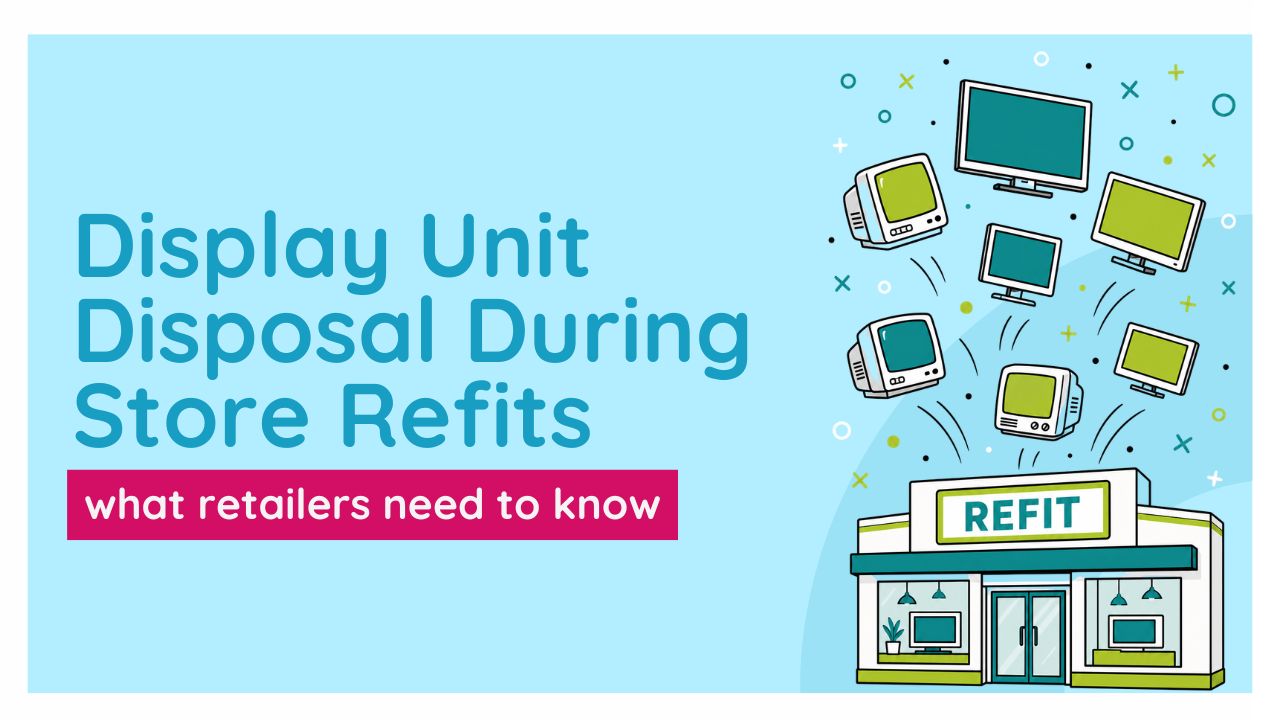
A store refit produces a lot of waste. Construction rubble, old fixtures, packaging - and most of it goes in a skip. Problems arise when display unit disposal is treated as part of the general construction clearance, creating compliance risks under WEEE regulations.
Most general construction waste skips are not intended for screens and display units, and many skip operators will refuse loads containing them. Or worse, the operator accepts it which creates a compliance problem for the retailer further down the line. The issue is that screens and display units are classified as Waste Electrical and Electronic Equipment (WEEE), and WEEE cannot be disposed of alongside general construction waste.
Under the Waste Electrical and Electronic Equipment Regulations 2013, display equipment is a defined category of WEEE. It’s Category 11 WEEE, which covers any screen or display unit that depends on electricity to function. In a retail environment, that means point of sales (POS) terminal screens, customer-facing monitors, back-office monitors, overhead video walls, and digital signage boards all fall within scope.
None of these can go in a general skip. They’re required to be transported by a licensed waste carrier and must be processed at an Approved Authorised Treatment Facility (AATF) - a facility approved by the Environment Agency to treat WEEE to the required standard.
This is not a grey area. The regulations are clear on how display equipment must be managed at end of life, and the responsibility sits with the organisation producing and managing the waste at the point it leaves site.
A mid-size retail refit will generate Category 11 WEEE from several sources that are easy to overlook when the project is being planned.
POS terminals are the most obvious. Category 11 WEEE also covers every checkout or service point with a customer-facing screen or operator monitor, meaning even a modest store can generate multiple display units during a refit.
Digital branding and signage is a common source of volume. Promotional screens, wayfinding displays, and queue management screens all fall within scope. A store with multiple promotional display zones can generate significant tonnage from signage alone. The volume of the waste really adds up when a company moves from legacy screens to newer display technology.
The growth of digital signage means that many retail, transport and commercial buildings now contain far more screens than they did a decade ago. A single video wall may contain six, nine or even dozens of individual display units. When those installations are replaced, each screen enters the WEEE stream separately.
It’s not all customer facing equipment. Back-office monitors, including those used at stock management stations, staff scheduling points, and cash office terminals, are also in scope. These are often overlooked in refit planning because they are operational, but they carry the same disposal obligations.
Planning the collection of all these streams as a single exercise, at specification stage rather than during the refit, produces cleaner outcomes. It avoids last-minute decisions about where screens go, reduces the risk of them ending up in general clearance, and gives the project a single point of documentation from the outset.
For retailers carrying out a full store refit that also involves commercial refrigeration, there is a practical case for using a single specialist WEEE partner for both streams. Commercial fridges are Category 12 WEEE - cooling appliances containing refrigerants — and require licensed handling under separate fluorinated gas, or F-Gas, and WEEE obligations. Before treatment, refrigerants must be removed and managed correctly, which is why fridge disposal follows additional compliance requirements alongside standard WEEE obligations. Screens are Category 11. The two categories require different handling, but they can be collected in the same planned exercise.
One visit with one set of documentation. One contact managing both compliance streams. That outcome is significantly cleaner than managing screens and fridges separately, with different carriers, different documentation, and different chains of responsibility. Not to mention other WEEE categories.
If your refit also involves commercial refrigeration, GAP's guide to commercial fridge disposal during store refits covers what the F-Gas and WEEE obligations mean in practice.
For Category 11 WEEE, you should receive either a waste transfer note or a hazardous waste consignment note, depending on the TV being disposed of. The documentation should clearly describe the Category 11 WEEE being removed, the parties involved in the transfer, and the date the waste left site. Under GOV.UK guidance on waste transfer notes, non-hazardous WEEE waste transfer notes must be retained for a minimum of two years and produced on request to the Environment Agency or local authority.
Your WEEE should also be processed at an AATF, and a competent operator will be able to confirm AATF status on request. This gives you a documented chain of custody from collection through to treatment which is exactly the kind of audit trail that matters if a compliance query arises after the refit is complete.
It is worth confirming at the point of instruction, not after collection, that your carrier is a licensed waste carrier and that the facility receiving the screens holds AATF approval. Checking a carrier's registration takes minutes using the Environment Agency's public register.
Disposing of screens and display units in a store refit? Talk to GAP.
GAP collects and processes Category 11 WEEE from retail refits across the UK. For stores also dealing with commercial fridges, we can manage both streams in a single planned collection. Contact the GAP retail team to discuss your project requirements.
Book a free review with our team. We'll look at how your organisation disposes of electricals today and show you exactly where your documentation falls short.