Corporate property WEEE: Simplifying Waste for Tenants
A managed WEEE collection service turns a hidden compliance gap into a building amenity, supporting BREEAM and GRESB reporting for commercial landlords.
Managing a multi-site estate? Get the free FM WEEE Compliance Guide.
Most commercial tenants renting office space aren’t sure what their building offers beyond desks and a lease. The waste electrical and electronic equipment (WEEE) collection service is rarely a service that is considered. But when a sustainability questionnaire asks about their WEEE disposal, they realise they don’t know what to do with it or where it goes. In a multi-occupancy building, it’s common for old monitors, cables and desk phones to accumulate. Perhaps there’s a collection in the plant room or a service corridor because nobody has taken responsibility for them. However, corporate tenants are increasingly asking what the building does about WEEE management, and property managers that aren’t able to answer leave tenants with a gap that shows up in lease reviews and BREEAM assessments alike.
A single-tenant business knows exactly who needs to manage WEEE. In shared building spaces, there can be confusion about who is responsible. The UK’s Environmental Protection Act 1990 states, under section 34, that each tenant in a building with multiple occupants carries its own duty of care for the controlled waste it produces. The rules also cover electrical equipment.
The Waste Electrical and Electronic Equipment Regulations 2013 define what counts as WEEE. Monitors, keyboards, desk phones, and the like all fall under the same regulations. These regulations are why they must be handled separately from general office waste once discarded. In a shared building, if the occupants don’t have a clear route for disposing of electrical waste, items tend to get stacked in a corner and dealt with eventually, or not at all.
The result is predictable: non-compliant disposal when someone finally clears the corridor, cluttered communal areas that reflect poorly on the building, and zero usable data for anyone trying to report on waste performance. None of this is unique to any one tenant's negligence. It's a structural gap that exists because WEEE collection was never built into the building's services in the first place.
A managed WEEE collection service closes the gap without transferring anyone's legal obligations. If a property manager offers a collect point for the different tenants to share, they don’t take on their occupants' duty of care. They're simply removing a barrier that prevents the tenants from meeting that duty of care themselves.
A collection service usually means providing a secure container or box that is placed in a shared area of the building. It could be a service area, bin store, near a service lift, or perhaps at reception points. But it will be accessible to every tenant on every floor. The appointed licensed carrier collects the waste from the container on a schedule that aligns with the building's occupancy and waste volume. A waste transfer note that confirms the WEEE route that was followed is generated with each collection. The facilities management (FM) team is then required to keep those notes on file for at least two years.
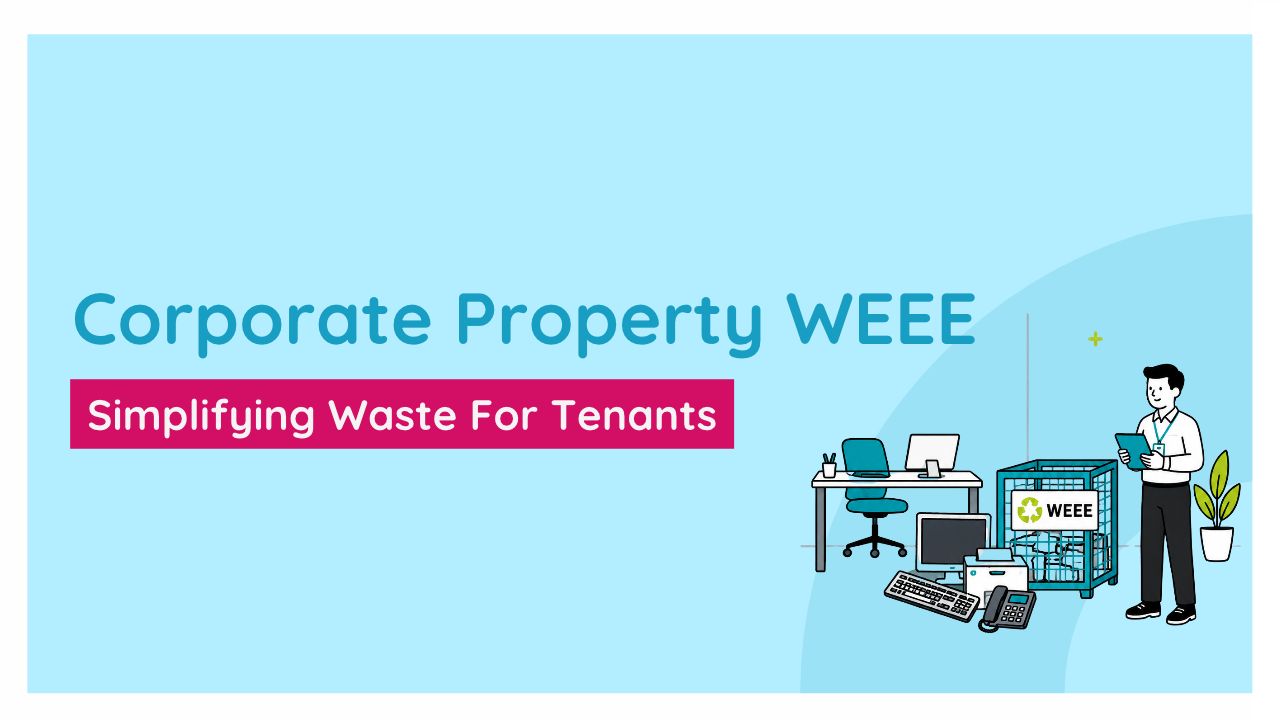
The collection service covers small electrical items that can quickly pile up, including monitors, desk phones, keyboards, cables, chargers, USB hubs and other IT peripherals that businesses would otherwise have to arrange disposal for.
Tenants tend to like having these services to hand as it requires very little effort. They don't need to explore options, take time researching to understand their obligations and then source an appropriate carrier, negotiate a contract, and keep track of their own waste transfer notes. They put items in the collection point and the building handles the rest.
Waste management and data is increasingly a part of how commercial buildings demonstrate their sustainability performance. Something that is under much more scrutiny now. A managed WEEE scheme offers a straightforward way to collect data that can be reported on. BREEAM In-Use, a standard to assess and benchmark the sustainability of all operational asset types, includes a dedicated waste management category. Using a documented WEEE collection process offers you evidence that can contribute toward your BREEAM score. The global sustainability intelligence standard for real assets (GRESB) offers another mechanism, the Real Estate Assessment, to assess and report on ESG performance with credibility. That assessment includes waste intensity as a performance metric, and consistent waste transfer note data from a building-level scheme supports that reporting.
It’s important to note that these claims should not be overstated. A WEEE collection scheme is one contribution among many other factors to BREEAM's waste criteria, and it supports GRESB's waste reporting. However it is not a standalone route to a higher rating. The value lies in having verified, building-level data to draw on, rather than estimating or leaving the waste category blank because no one has been gathering the right information and figures. For tenants with their own environmental management certification, such as ISO 14001, a building that can produce this kind of documented waste record is also easier to work with when they're compiling their own environmental data.
The service works best when it's introduced as exactly that: a service, not a new rule. Tenants aren't being asked to change how they handle their waste obligations. They're being offered a route that's already set up, already compliant, and documented.
This is something that lands particularly well with corporate tenants working through their own supply chain sustainability questionnaires. Companies are now expected to show that the buildings they occupy have a responsible waste disposal system, not just general recycling bins in the kitchen. Being able to point to a scheduled WEEE collection point that comes with the supporting waste transfer notes provides a solid answer.
If you want to set up a scheme in your building or portfolio of buildings, it’s worth confirming a few details with your proposed supplier. The chosen carrier should hold an upper-tier waste carrier's licence, checkable in minutes through the Environment Agency's public register. The treatment facility receiving the WEEE should hold Approved Authorised Treatment Facility status. And every collection should come with a waste transfer note as standard, not as something you have to request after the fact.
GAP provides managed WEEE collection services for commercial office buildings and multi-tenant estates, with flexible collection schedules and waste transfer notes for every visit. Talk to GAP about setting up a WEEE collection scheme for your building.
Book a free review with our team. We'll look at how your organisation disposes of electricals today and show you exactly where your documentation falls short.