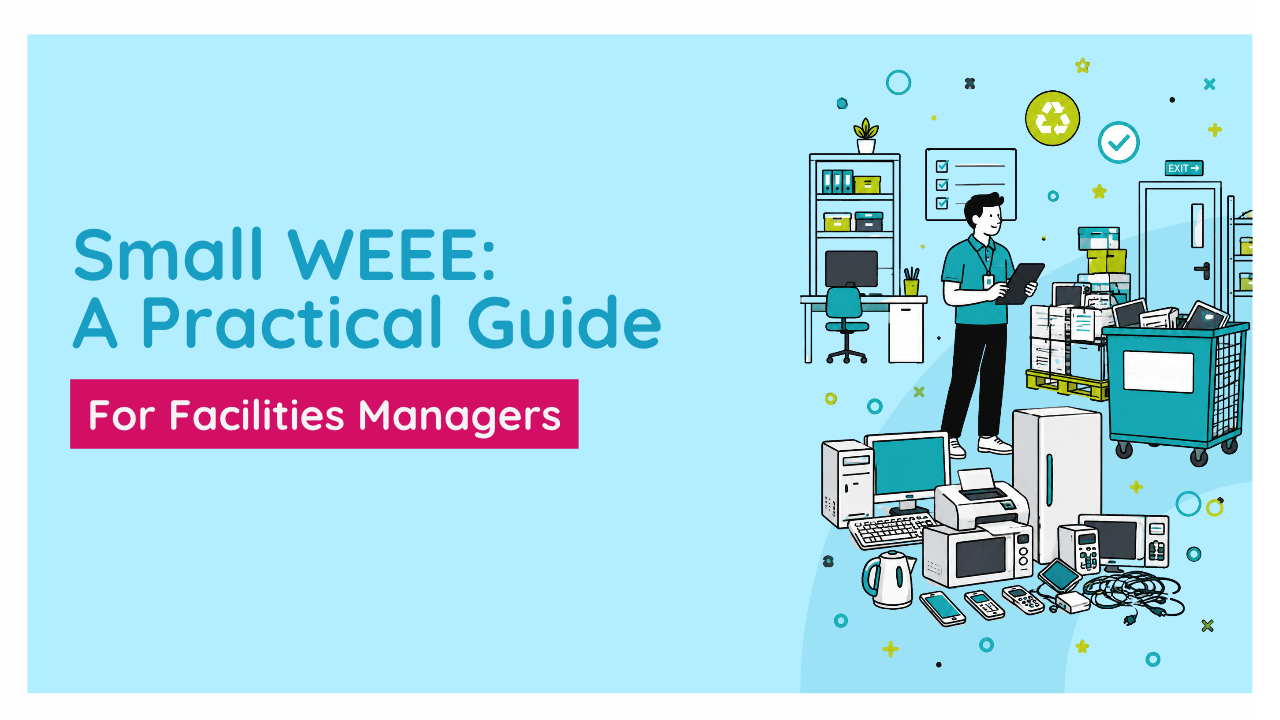
Small WEEE: A Practical Guide for Facilities Managers
Setting up a small WEEE collection across a facilities management portfolio? Here's what to check before you commit to a provider, and how long to keep the paperwork.
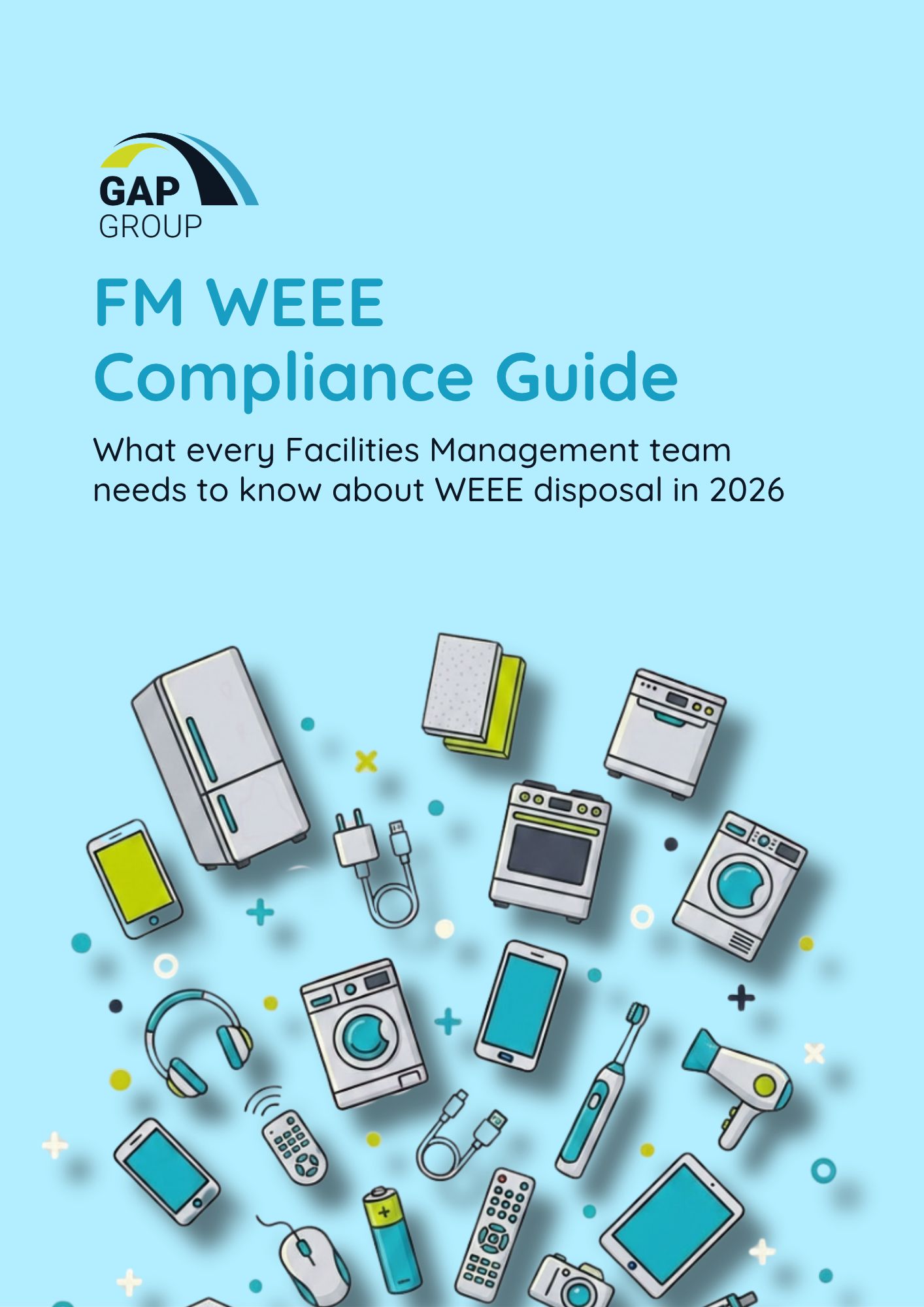
Get the checklist for every site: download the free FM WEEE Compliance Guide.
Every managed building accumulates the same things: old phones, cables with no device attached, unused keyboards. It looks pretty innocuous sitting there, not urgent. However, that way of thinking can cause compliance problems. Setting up a reliable small waste electrical and electronic equipment (WEEE) collection across a facilities management portfolio is a way for you to manage risk.
Regardless of whether your portfolio covers five properties or has fifty, this is likely to be an issue that has arisen. One of your clients asks for evidence that electrical waste is handled properly. Then an internal audit shows a site where phones and chargers went into general waste. So you need to ask, what is the best way to set up a WEEE collection? And, what should you check before you commit to a provider?
Items considered small waste electrical and electronic equipment are broader than most facilities management (FM) teams expect. Phones, tablets, laptops and their charging cables are obvious examples. So are USB hubs, desk phones, conference call equipment, keyboards and mice. What may come as a surprise is that portable appliances like kettles, toasters, and heaters also count. In addition, power tools and small IT peripherals fall into the same category, along with most battery-powered devices.
What does not fall into this stream also matters. Large white goods like fridge-freezers are handled through a separate stream, under different regulatory requirements covering refrigerants. Mixing the two at the point of collection creates problems further down the chain, so it is worth being specific with any provider about exactly what “small WEEE” covers on your sites.
The Waste Electrical and Electronic Equipment Regulations 2013 say that whatever its size, WEEE sits outside general waste collection and should be routed through a licensed carrier to an approved treatment facility.
The legal duty for waste removal is with whoever produces the waste, under Section 34 of the Environmental Protection Act 1990. In a managed building, that duty usually sits with the tenant or occupier, not the FM team or the landlord. This distinction helps understand where responsibilities and compliance lie. A FM team's job is not to take on legal responsibility for waste a tenant has produced. It’s to make sure a compliant route exists on-site for the tenants. In addition, it’s important that its use is backed by the documentation required under the Environmental Protection (Duty of Care) Regulations 1991, so you reduce risk of non-compliant disposal happening on your premises.
As a FM, you are not absorbing a legal duty that is not yours. You are removing the reason tenants or building users default to the nearest general waste bin, which is usually that no better option has been put in front of them.
For a multi-site portfolio, the solution can be simple: use a trusted provider container that is emptied to your agreed schedule. Secure containers are placed in communal areas such as near bin stores, service lifts or reception points. Then tenants deposit their small waste items as needed. This alleviates pressure on the businesses as they have a clear way to dispose of waste without needing specialist knowledge.
The container is collected on a defined schedule by a licensed carrier. Boxes can also be emptied on request once they reach capacity. It’s possible to flex the frequency per site in the contract. A smaller building with fewer occupants may only need a monthly pickup, whereas a larger mixed-use building may generate more volume and need a collection every week. Each collection is logged, and the items move on to an authorised treatment facility for processing.
The advantage of this system is that it is consistent across every building that you manage. You have one scheme that covers every site, one point of contact with your supplier, and one documentation process to maintain. Consolidation is a practical win.
If you’re ready to use a provider for WEEE disposal across your commercial buildings, there are a few things you should consider before you commit.
Check their waste carrier registration. Collecting other people's waste requires upper tier registration with the Environment Agency, which is renewed every three years. The EA's public register has a search tool that allows you to look by either company name or registration number and you will see if the registration is current.
Ask where the waste ends up. A compliant collection has to be processed at an Approved Authorised Treatment Facility (AATF). A trusted provider should be able to confirm the AATF status for the facility receiving your waste.
Confirm the documentation you will receive. A waste transfer note should be issued for every collection. That note should describe what was collected, who collected it, and when. To meet regulations, this note is needed and a provider should be able to commit to this as standard practice. If there’s any hesitation, it's a good reason to look for alternative options.
These three questions and a few minutes to check against a public register will give you all the information you need.
Waste transfer notes for non-hazardous WEEE need to be kept for a minimum of two years. That is different from hazardous waste consignment notes, which require three years' retention, so it is worth not rounding the two together if any of your sites also generate hazardous electrical waste such as fluorescent lighting.
For FM teams, these waste transfer notes are the evidence base for facilities management WEEE compliance. So you are ready if a client asks for proof that electrical waste is handled properly, or there’s an audit that requires a paper trail. A complete set of waste transfer notes that cover every collection at every site gives you the evidence you need.
A small WEEE collection arrangement can be simple. You do not need to create a new system at every new site you take on. Once the container scheme, the collection schedule and the documentation routine are in place, it runs with minimal ongoing input from the FM team, across all the sites in your portfolio.
GAP provides small electrical waste collection for facilities management portfolios, with containers supplied, scheduled nationwide collection, and a waste transfer note for every visit. Talk to GAP about small WEEE collection for your portfolio.
Book a free review with our team. We'll look at how your organisation disposes of electricals today and show you exactly where your documentation falls short.