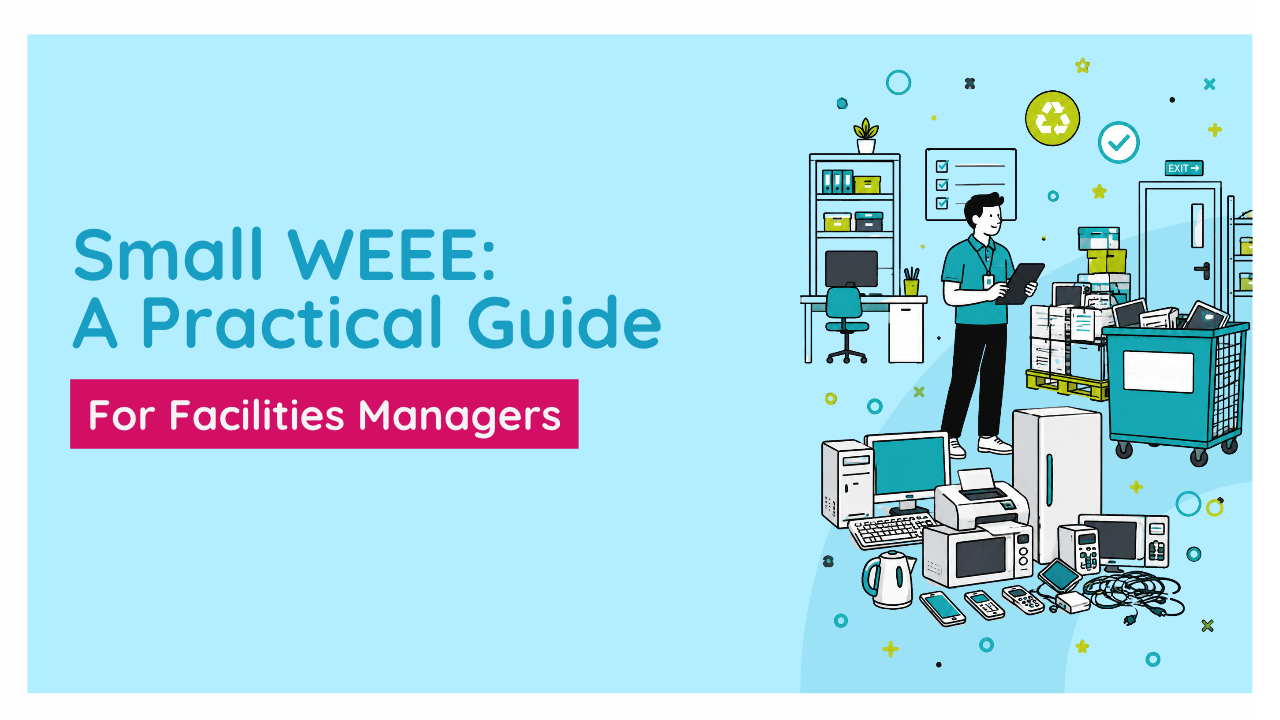
When the time comes to update your organisation's old IT equipment, you might be wondering about the best way to deal with your current and future WEEE. Do you need to set up a WEEE compliance process for your UK business? Or is this actually unnecessary given your operations?
E-waste disposal doesn’t have to put more work on your plate. For the majority of businesses, a waste disposal partner can do the hard yards for you.
Business WEEE obligations in the UK: what you're actually required to do
The first thing to know is that if you create WEEE as a byproduct of your operations – including old laptops and keyboards – your business is classed as a ‘business user’ as opposed to a producer of electrical equipment. This means the process of disposing of this waste will be straightforward.
The relevant regulations here are the WEEE Regulations 2013 and Section 34 of the Environmental Protection Act 1990, which sets out a company's WEEE duty of care. Under the act, you can’t wash your hands of the waste you produce when it leaves your site – it’s your responsibility to ensure it is safely and properly treated.
While this might sound daunting, staying on the right side of the law is simple.
First, you need to make sure your waste is picked up by a licensed waste carrier, whose details are registered with the Environment Agency.
The carrier must take your waste to an approved authorised treatment facility (AATF) for recycling, ensuring your waste is responsibly dealt with.
They’ll also give you a waste transfer note, which you’ll need to keep for two years in the case of non-hazardous WEEE, like keyboards or toasters. For hazardous WEEE, such as fridges or devices containing certain types of batteries, you’ll be provided with a consignment note you should hold onto for three years.
Which type of business are you?
While any business might need to dispose of WEEE, whether your business needs a WEEE compliance process or not depends on which of two camps you fall into.
Type A businesses only generate WEEE every once in a while, such as when their IT equipment is periodically refreshed.
Type B businesses produce a high volume of WEEE, potentially across multiple sites. Because they deal with WEEE so frequently, they’ll need to establish an internal process to track and report on how they dispose of it in order to meet auditors’ expectations.
Type A businesses, on the other hand, simply need to properly dispose of their WEEE as and when needed.
What 'good enough' looks like for Type A
Most businesses will fall into the category of Type A. If your business does, and you’re wondering how to comply with WEEE regulations, it’s much simpler than you might think.
Dealing with your e-waste in a safe, compliant, and sustainable way largely comes down to who you contract to collect and recycle your waste.
You must find a licensed collection partner who takes your e-waste to an AATF. For each transaction, you’ll need to ensure you’re provided with a waste transfer note or consignment note – which you’ll need to hold on to for two or three years, respectively. If you tick all of those boxes, you’ve fulfilled your duty of care.
If you're disposing of laptops or other data-bearing equipment, secure data destruction is a separate requirement from WEEE compliance, so make sure this is arranged too.
What Type B businesses actually need
Because of the amount and frequency of WEEE they need to dispose of, Type B businesses need to procure significantly more data about their e-waste that they can pass on in the event of an audit.
This includes:
- Information about the WEEE each site of their business produces, and when it is collected.
- Regular reporting on a monthly or quarterly basis about the type and amount of WEEE produced and collected, backed up by waste transfer notes or consignment notes.
- Data on the materials that were recovered from their WEEE and recycled by the treatment facility, which can form a part of their company sustainability and ESG reporting.
The good news if you are a Type B business is that a good waste collection partner will provide this data for you. You don’t need to build a tracking system from scratch.
What to ask a WEEE collection partner
Whether you’re a Type A or Type B business, it’s crucial that you make the right choice about who you work with on WEEE disposal.
To check you’re partnering with someone who will make sure everything is up to scratch, there are three questions you should ask:
1. Do you have an upper tier carrier licence?
This licence is crucial, as without it your waste carrier will be committing a criminal offence – and you will not have met your duty of care. Ask for their registration number and look it up on the EA’s register.
2. Will you take my WEEE to an AATF?
Make sure you get the name of the facility where your waste will be taken. Then, check against the EA public register to make sure this site has been assessed by the regulator as being up to standard.
3. Will you supply me with a waste transfer note or consignment note?
Without this note, you have no legal proof that you’ve fulfilled your duty of care. You’ll need to hold on to the documentation they supply you with for two years in the case of non-hazardous waste and three years for hazardous waste.
Choose a fully compliant partner for WEEE disposal
To stay on the right side of regulation, speak to GAP about a WEEE collection partnership for your business.